
Meanwhile, with China switching its trading partners due to geo-political issues, increased trade with South Africa for bauxite and with the US for coal is also auguring well for vessels with tonne miles going up.

Overall, Tata Steel becomes the seventh non-financial firm, including four oil PSUs to report quarterly revenues of Rs 50,000 crore.

With the government looking to divest loss-making steel assets, significant interest from secondary players is most likely this time apart from the anticipated list of large integrated primary steel producers, said industry experts. Rashtriya Ispat Nigam Limited (RINL), Neelachal Ispat Nigam Ltd (NINL), NMDC Integrated Steel Plant (NISP)-Nagarnar, Ferro Scrap Nigam Ltd and three units of Steel Authority of India (SAIL) - Alloy Steels Plant, Durgapur; Visvesvaraya Iron and Steel Plant, Bhadravati; and Salem Steel Plant, Salem - constitute the divestment list. All the three units of SAIL have been loss-making for more than five years.

Earnings growth in the early-bird sample has been driven by banks and iron & steel companies.

However, experts caution that investors should not expect the big returns they got from the sector between March and September 2020.

Together with its share buyback worth Rs 16,000 crore completed in January this year, TCS shareholders will receive a record Rs 30,250 crore from their company in FY21.

The earnings are, however, expected to be down around 2 per cent on a sequential basis due to pent-up demand getting exhausted and the adverse impact of rising metals and energy prices on consumer goods and manufacturing companies.
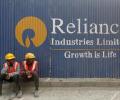
With the O2C business outlook on the mend, the Street is also looking forward to news on RIL's proposal to sell up to 20 per cent of the O2C business to a strategic investor like Saudi Aramco.

India Inc's cash pile was up 13.8 per cent last fiscal year, thanks to a combination of higher profits in sectors such as IT and fund raising by top companies such a Reliance Industries, Bharti Airtel and Tata Motors, among others.

Adani Ports and Special Economic Zone and Adani Green Energy are the other two Adani Group firms to have crossed the Rs 1-trillion mark in m-cap.

Tata group companies have outperformed the broader market over the past four years, under the chairmanship of N Chandrasekaran. However, the group's fortunes rely heavily on the performance of Tata Consultancy Services (TCS) now, as compared to the past. The combined market capitalisation of the group's listed companies has nearly doubled in the last four years, against a 77 per cent rally in the benchmark Sensex during the period. The overall market value of 16 key group firms - excluding listed subsidiaries of such entities - stood at Rs 16.8 trillion as of Friday. This was close to 2x the Rs 8.45 trillion as of February 21, 2017 - the day Chandrasekaran took charge as chairman of Tata Sons.

'We are working in association with the state government and other transmission companies to make sure that the city never experiences blackouts'

India Inc's quarterly net profit reached a record high of Rs 1.64 trillion in the third quarter ended December 31, 2020, mainly due to gains from higher commodity prices and a big swing in banks' earnings. The combined net profit of 3,323 listed companies that have declared results so far was up 68.6 per cent year-on-year (YoY). In comparison, earnings were up six times (534 per cent) in the second quarter and 6.5 per cent in the corresponding period last year.

About 50,000 truckers, most of whom are single-truck owners, could be thrown off their businesses due to the recent fuel price hike. "Already the vehicle supply on the road is higher than the requirement. "With the fuel price hike, fleet owners will look to cut down fleet size wherever needed and due to this, small single-truck owners could be at the receiving end," Ashok Goyal, managing director at BLR Logistiks (I) Ltd said. The company has a fleet of 500 vehicles of all types-small, medium and large with pan-India presence.
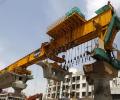
The combined net sales of 42 listed construction and capital goods companies that have declared their third-quarter results so far were down 2.3 per cent year-on-year in Q3FY21 while core operating profit was up just 4.9 per cent YoY during the quarter.

Market cap of government companies has remained unchanged in the past 8 years.

Companies are looking to combine risk management with strategy.

BSE-listed companies' market capitalisation reached Rs 197.7 trillion on January 21, against India's nominal GDP of Rs 190 trillion during 12 months ended December 2020.

Over the three-month period, Airtel's stock price has rallied from Rs 432 to Rs 540, while Vodafone Idea has risen from Rs 9.2 to Rs 11.8 per share.

This is first time in 25 years that a benchmark equity index in India is trading at a P/E multiple of 40x or higher.
 © 2026 Rediff.com - Advertise with us - Disclaimer - Privacy Policy - Sitemap - Feedback - About us - Terms of use - Grievances